
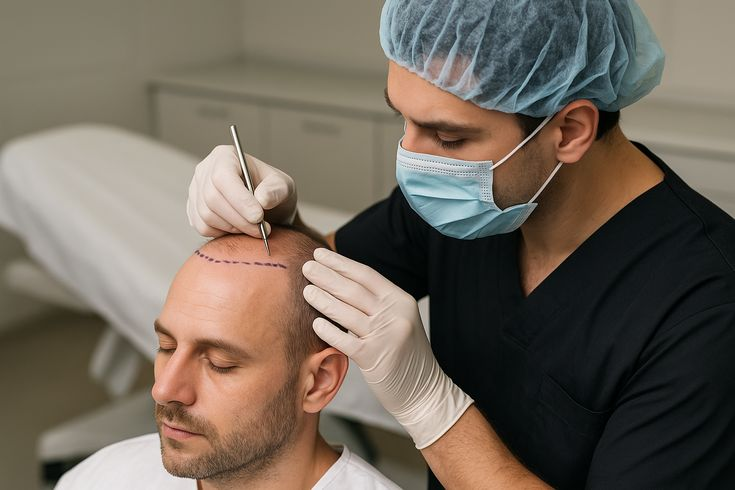
In an industry where over 70% of hair transplant clinics in India delegate the actual procedure to trained technicians, a growing number of patients are asking a question that could determine the success or failure of their results: who is actually touching my grafts?
The distinction between a doctor-performed and a technician-performed hair transplant is not a matter of semantics. It is a clinical difference that directly impacts graft survival rates, implantation precision, and the naturalness of the final outcome. Yet most patients walking into a hair transplant clinic today have no idea that the surgeon they consulted with may not be the one performing their procedure.
The Technician Model: How It Works
In the majority of hair transplant clinics across India, the process follows a predictable pattern. The patient consults with a doctor. The doctor may perform the first few extractions. Then, for the remaining 4-8 hours of the procedure -the extraction of thousands of individual follicular units, the creation of recipient slits at precise angles and depths, and the implantation of each graft -trained technicians take over.
These technicians are not doctors. They do not hold medical degrees. They have been trained on-the-job to handle specific steps of the procedure. In some clinics, the supervising doctor may not even be in the room for the majority of the surgery.
The reason is economic. A single surgeon can oversee multiple procedures running in parallel if technicians handle the work. It allows clinics to perform 3-4 procedures per day instead of 1-2, dramatically increasing revenue.
Why It Matters Clinically
Every hair graft is a living tissue. From the moment it is extracted from the donor area to the moment it is placed in the recipient site, the graft is vulnerable. The angle of extraction determines whether the follicle is intact or transected. The depth and angle of the recipient slit determines whether the graft sits naturally or grows in an unnatural direction. The speed and care of implantation determines whether the graft survives or dies.
“A damaged graft does not grow back. If a technician transects even 5% more grafts than a trained surgeon would, that is 150-200 lost follicles in a typical 3,500-graft procedure. Those are follicles the patient can never recover,” said Dr. Abhishek Pilani, Co-Founder of Assure Clinic and member of the International Society of Hair Restoration Surgery (ISHRS).
The numbers bear this out. Doctor-performed procedures consistently report graft survival rates of 90-95%. Technician-performed procedures, depending on the skill level and supervision quality, range from 70-85%. The gap -10-25% -is the difference between a full, natural result and a visibly thin one.
The Assure Clinic Approach
Assure Clinic, which operates across 13 cities in India and Dubai, was built on a single principle: the doctor performs every step of every procedure. No technicians extract grafts. No technicians create recipient slits. No technicians implant follicular units.
This is not a supervisory model where the doctor watches over technicians. It is a hands-on model where the surgeon’s hands are the only ones that touch the patient’s grafts -from the first extraction to the last implantation.
The clinic uses the UHDHT (Ultra High Density Hair Transplant) technique, which achieves 60-80 grafts per square centimetre compared to the 35-40 grafts typical of standard FUE procedures. This higher density requires surgeon-level precision at every stage -which is precisely why it cannot be delegated to technicians.
“We could see more patients per day if we used technicians. Every clinic chain faces that temptation. But the survival rate would drop, the density would drop, and the patient’s result would suffer. That is not a trade-off we are willing to make,” Dr. Pilani explained.
What Patients Should Ask
Before choosing any hair transplant clinic, patients should ask three direct questions:
1. Will the doctor perform the entire extraction and implantation? If the answer involves words like “team,” “supervised,” or “trained staff,” it means technicians will handle most of the procedure.
2. What is the clinic’s documented graft survival rate? Clinics that track outcomes transparently will share this number. Anything below 90% should prompt further questions about who is performing the procedure.
3. What density can the clinic achieve per square centimetre? Standard FUE delivers 35-40 grafts/cm². Higher density techniques like UHDHT deliver 60-80 grafts/cm² -but this requires doctor-level precision that technicians typically cannot replicate.
The Scale Question
The most common argument for the technician model is scale. Clinics argue that using technicians allows them to serve more patients. Assure Clinic’s 13-city presence -with centres in Mumbai (3 locations), Bangalore, Hyderabad, Ahmedabad, Dubai, and eight other cities -demonstrates that a doctor-only model can scale without compromising on the principle.
The chain has completed over 20,000 procedures across its network, maintaining a 95% graft survival rate. Every procedure, in every city, follows the same doctor-only protocol.
“The answer to scale is not to dilute quality. It is to train more surgeons and open more centres. That is what we have done across 13 cities, and that is what we will continue to do,” said Dr. Abhishek Pilani.
The Patient’s Right to Know
At its core, the doctor-versus-technician question is about informed consent. Patients have the right to know who will be performing their procedure. They have the right to expect that the surgeon they consulted with is the one handling their grafts. And they have the right to choose a clinic where this is guaranteed -not assumed.
For patients considering a hair transplant anywhere in India or Dubai, the first question to ask is not about cost or technique. It is: will my doctor perform the entire procedure?
The answer to that question will determine everything else.
Assure Clinic operates doctor-only hair transplant centres in 13 cities across India and Dubai. For consultations, visit assureclinic.com.
