What if humanity's greatest problems are not caused by evil intentions, but by good intentions that are never questioned?
Throughout history, humanity has searched for the source of evil.
History remembers wars by their destruction.
It remembers revolutions by their consequences.
It remembers injustice by its victims.
But history quietly conceals another, more uncomfortable truth.
Almost nobody involved believed they were the villain.
The soldiers believed they were defending their nation.
The rulers believed they were preserving order.
The revolutionaries believed they were delivering justice.
The judges believed they were protecting morality.
Each side believed it was right.
History eventually judged many of them differently.
That observation raises a question few people pause to ask.
If so many of humanity's greatest tragedies were committed by people convinced they were doing the right thing...
What if the greatest danger isn't evil?
What if it's certainty?
For nearly two decades, that question has quietly accompanied Prasanth Kumar Vinakota through boardrooms, technology projects, enterprise transformation initiatives, classrooms, and eventually into philosophy.
His conclusion is neither cynical nor provocative.
It is remarkably simple.
The greatest danger is not goodness itself. It is goodness that loses the ability to question itself.
A Journey That Began Far from Boardrooms
Raised in the small town of Anakapalle, Andhra Pradesh, Prasanth Kumar Vinakota's journey began far from technology campuses, publishing, or entrepreneurship.
Higher education came through determination rather than privilege. Supported by an education loan from Andhra Bank, he balanced work to support his family while attending evening classes at LIBA, learning early that responsibility often arrives long before opportunity.
Those years shaped more than his career.
They shaped the questions he would spend the rest of his life exploring.
He observed that two people could experience similar circumstances yet arrive at completely different lives, not because reality was different, but because the way they interpreted reality was different.
That realization stayed with him.
Building Systems, Solving Problems
Over the next two decades, Vinakota established himself in enterprise technology and HR systems, working at the intersection of digital transformation, automation, analytics, and organizational change.
His professional journey included contributions to nationally significant projects such as INS Arihant, India's first nuclear-powered ballistic missile submarine, before moving into senior HR Systems leadership, where he helped organizations modernize complex people and technology systems.
Processes could be redesigned.
Systems could be optimized.
Data could reveal patterns.
Problems could be solved.
Yet something continued to puzzle him.
The organizations he worked with were filled with intelligent, capable, and fundamentally decent people.
Why, then, did misunderstanding remain so common?
Why did organizations with talented employees still struggle with unhealthy cultures?
Why did families continue repeating the same conflicts across generations?
Why did people with genuinely good intentions so often hurt the very people they wanted to protect?
He always wondered why human beings behaved the way they did.
That question became the turning point.
Beyond Technology
Rather than dismissing those questions as philosophical abstractions, Vinakota began studying them with the same discipline he had applied to technology.
He immersed himself in psychology, philosophy, organizational behaviour, leadership, spirituality, history, and the patterns underlying human decision-making.
The more he observed, the more one conclusion became difficult to ignore.
Humanity was not suffering from a shortage of intelligence.
Nor from a shortage of information.
It was suffering from a shortage of awareness.
In an age where artificial intelligence is rapidly transforming the way people work, Vinakota believes this distinction has become even more important.
Machines may continue becoming more intelligent.
But the consequences of every technological breakthrough will still depend on the quality of human judgment.
Technology can increase capability.
Only awareness can determine whether that capability creates progress or suffering.
From an Idea to a Movement
Those observations gradually evolved into something much larger than personal reflection.
They became the foundation of a broader vision.
Vinakota founded Leksi Smart to help individuals and organizations embrace technology more effectively through learning, automation, artificial intelligence, and workplace transformation.
Over the years, he has trained thousands of professionals, developed productivity solutions, and helped organizations adapt to changing technologies.
But even while building technology solutions, another vision continued taking shape.
One that could not be expressed through software alone.
It required a different medium.
It required stories.
It required philosophy.
It required people to question not the world around them, but themselves.
That vision would eventually become his first published work.
When a Book Becomes More Than a Book
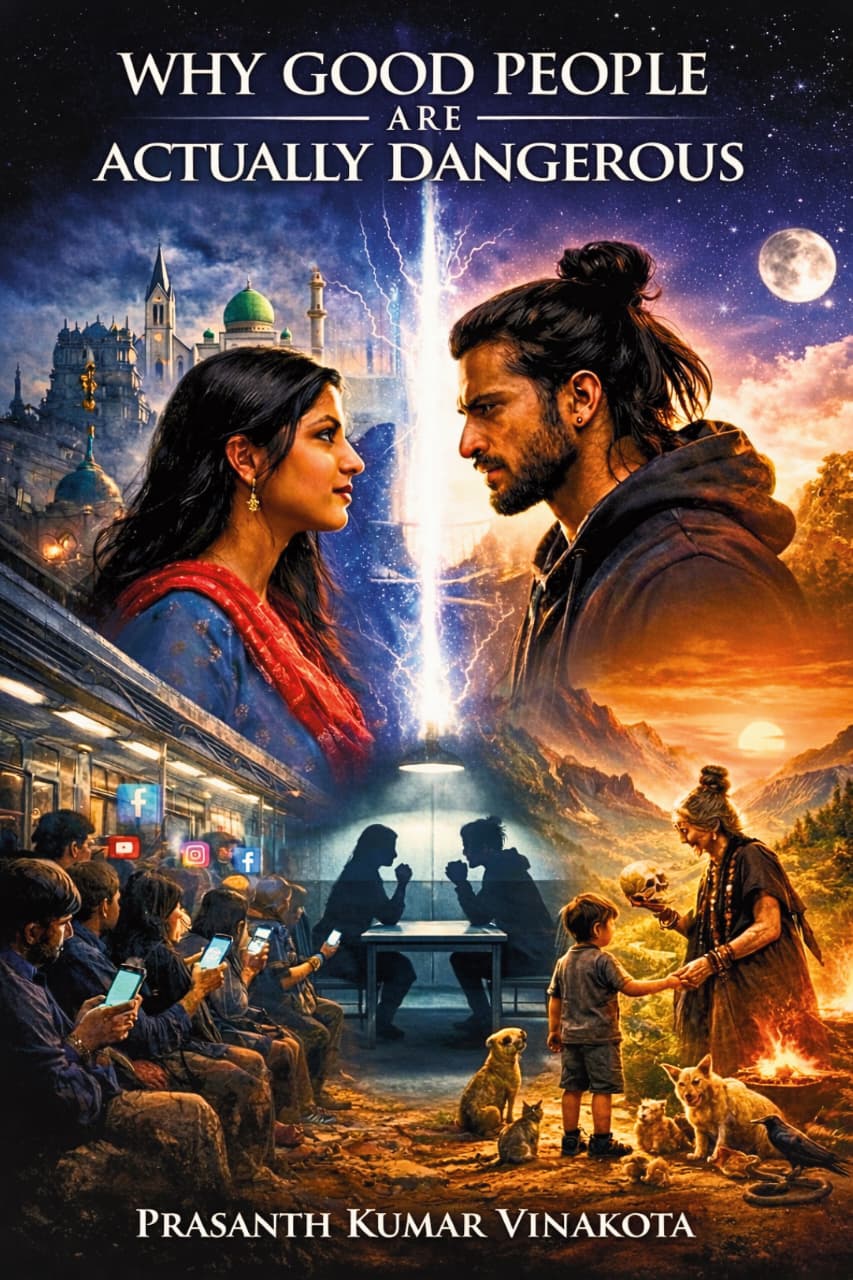
That vision eventually found its first public expression in Why Good People Are Actually Dangerous: The Hidden Cost of Moral Certainty.
Unlike traditional self-help books that promise confidence, success, or happiness, Vinakota's work asks readers to confront a far more uncomfortable possibility.
What if the greatest harm in the world is often caused by people who sincerely believe they are doing the right thing?
Through the intertwined lives of two unforgettable characters, Saira and Pashi, the book explores how identity, fear, perception, morality, and certainty quietly shape human behaviour.
Rather than dividing humanity into good people and bad people, it asks readers to examine something much closer to home.
Their own certainty.
At the heart of the book are two original conceptual frameworks MIST and TRIL developed through years of observation and reflection. Rather than offering another formula for success, these frameworks invite readers to observe not merely what they think, but how they think.
Vinakota believes lasting transformation rarely begins with better answers.
It begins with better questions.
Recognition Beyond Conventional Categories
Although independently published, Why Good People Are Actually Dangerous has rapidly begun attracting international editorial recognition for both its originality and its intellectual ambition.
The book received a 5-Star Editorial Review from Readers' Favorite, where it was praised as a thought-provoking exploration of morality, truth, and human behaviour that encourages readers to examine their own beliefs rather than simply confirm them.
It also received recognition from Deified Publications, which highlighted its unique ability to combine narrative storytelling with philosophy and psychology while introducing original frameworks that challenge conventional assumptions about goodness and certainty.
Most recently, the book received an exceptional review from Jim Cox, Editor-in-Chief of the Midwest Book Review, one of the most respected independent literary review organizations in the United States.
Describing the work as "original, timely, informative, deftly crafted, thought-provoking, and a simply fascinating study from start to finish," Cox recommended it for readers interested in Behavioral Psychology, Social Philosophy, and Psychology Movements, while also recommending it for personal, professional, community, and college/university Psychology, Sociology, and Philosophy collections.
For an independently published debut work, such recognition represents more than positive reviews. It suggests that the ideas themselves are beginning to enter broader intellectual conversations.
Across these independent editorial voices, one message consistently emerges.
The book does not merely provide answers.
It changes the questions readers ask themselves.
Building an Ecosystem of Technology, Knowledge and Wisdom
For Vinakota, however, the book is not the destination.
It is only the beginning.
Through Leksi Smart, he is building an ecosystem that connects three domains that are rarely brought together.
Technology.
Knowledge.
Wisdom.
Today, that ecosystem includes AI-powered productivity tools, enterprise consulting, workplace learning, and intelligent automation.
Tomorrow, it aims to extend far beyond technology.
His long-term vision includes a continuing series of books, original research into human behaviour, awareness-centered learning experiences, podcasts, public speaking, AI-assisted educational platforms, and the development of a structured Behavioral Learning System designed to help individuals and organizations better understand themselves before attempting to change others.
His philosophy is deceptively simple.
Technology helps people work better.
Knowledge helps people perform better.
Awareness helps people live better.
Looking Beyond Motivation
Much of today's personal development industry encourages people to become more confident.
More productive.
More successful.
Vinakota believes something more fundamental deserves humanity's attention.
Becoming more aware.
Because confidence without awareness becomes arrogance.
Knowledge without awareness becomes certainty.
Power without awareness creates consequences.
In a world increasingly shaped by artificial intelligence, algorithms, and automation, he believes humanity's greatest competitive advantage will not be intelligence alone.
It will be the ability to observe oneself honestly.
To question deeply.
To remain open to being wrong.
Because history repeatedly reminds us that humanity's greatest mistakes were rarely committed by people who wanted to do evil.
They were committed by people who stopped questioning whether they might be wrong.
A Different Question for the Future
Artificial intelligence will continue changing the way humanity works.
But technology alone cannot decide humanity's future.
Every breakthrough...
Every organization...
Every institution...
Every nation...
And every generation...
Will ultimately be shaped by the quality of the decisions human beings make.
For Prasanth Kumar Vinakota, that is why awareness matters.
Because the greatest threat has never been intelligence without capability.
It has always been capability without awareness.
Perhaps the defining question of the coming decades is no longer,
"How do we build smarter machines?"
But rather,
"How do we become wiser human beings?"
About Prasanth Kumar Vinakota
Prasanth Kumar Vinakota is the Founder of Leksi Smart, creator of the Leksi AI Ecosystem, HR Systems leader, author, researcher, and speaker exploring the intersection of technology, human behaviour, philosophy, and awareness. With nearly two decades of experience spanning enterprise technology, digital transformation, automation, workplace learning, and organizational systems including contributions to nationally significant projects such as INS Arihant, he is building a long-term ecosystem that integrates artificial intelligence, books, research, behavioural learning, and awareness-centered education.
His work has received international editorial recognition from Readers' Favorite, Midwest Book Review, and Deified Publications, and his broader vision is to positively impact 10 million lives by helping people think better, work smarter, and act more responsibly through technology, knowledge, and wisdom.